Posts

Showing posts with the label tariff impact

U.S. Stock Market Summary for Tuesday, April 22, 2025
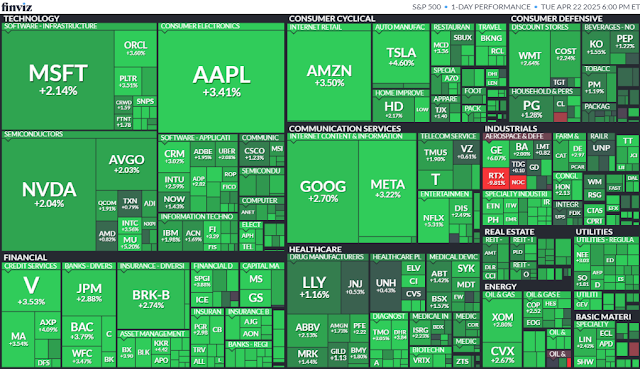
Image
  Major Indices S&P 500 : +2.5% to 5,287.76 Dow Jones Industrial Average : +2.7% to 39,186.98 Nasdaq 100 : +2.63% to 18,276.41 Russell 2000 : +2.7% to 1,890.28 Market Overview U.S. equities rallied on Tuesday, with major indices surging over 2% amid a broad-based recovery fueled by upbeat corporate earnings and renewed optimism on trade. Treasury Secretary Scott Bessent's remarks hinting at progress in U.S.-China trade negotiations provided a tailwind to investor sentiment, helping markets bounce back from recent losses. Strong performance in large-cap and technology stocks further reinforced the day's bullish tone. Sector Highlights Equifax (EFX) surged 13.8% following a stellar Q1 earnings report, a dividend hike, and a $3 billion stock buyback announcement. First Solar (FSLR) jumped 10.5% after the U.S. government imposed strict antidumping duties on solar imports from Southeast Asia. Pentair (PNR) climbed 9.2%, outperforming despite declini...

U.S. Stock Market Summary for Monday, April 21, 2025

Image
Major Indices S&P 500: -2.36% → 5,158.20 Dow Jones Industrial Average: -2.48% → 38,170.41 Nasdaq 100: -2.46% → 17,808.30 Russell 2000: -2.14% → 1,840.32 All major indices closed sharply lower, with the S&P 500 now down nearly 16% from its February high, approaching bear market territory. Market Overview U.S. equities plunged Monday amid a storm of political and monetary uncertainty. President Donald Trump escalated his rhetoric against Federal Reserve Chair Jerome Powell, branding him a “major loser” and calling for immediate rate cuts. These comments ignited concerns over the Fed's independence, further rattling investor sentiment already shaken by aggressive new tariffs on Chinese and EU imports. The U.S. Dollar Index fell to a 15-month low as investors fled to safe havens, with gold and the Swiss franc seeing strong inflows. Equities saw broad-based selling; decliners outnumbered advancers by nearly 5-to-1 on the NYSE, and overall volume remained subdued...

U.S. Stock Market Summary for Wednesday, April 16, 2025

Image
  Major Indices U.S. equities tumbled sharply on Wednesday as trade tensions with China escalated and concerns over monetary policy direction deepened. All major indices closed lower: S&P 500 : -2.24% → 5,275.70 Dow Jones Industrial Average : -1.73% → 39,669.39 Nasdaq-100 : -3.04% → 18,257.64 Russell 2000 : -1.03% → 1,863.48 Year-to-date, the Nasdaq-100 and Russell 2000 remain deeply in negative territory, down 15.6% and 16.4% , respectively. Market Overview Investor confidence was rattled after the U.S. government announced new export restrictions on AI chips to China , primarily affecting Nvidia , which warned of a potential $5.5 billion revenue loss . The chipmaker’s stock plunged nearly 9% , erasing approximately $250 billion in market capitalization. AMD followed suit, falling 7.4% on a projected $800 million impact. Further pressuring markets, Federal Reserve Chair Jerome Powell signaled heightened inflation risks due to new tariffs under President Tr...

Jerome Powell’s April 16 Speech: Tariffs May Trigger Inflation-Growth Trade-Off, Fed Stays Cautious

Image
Federal Reserve Chair Jerome Powell acknowledged signs of slowing growth in the U.S. economy during his April 16 remarks at the Economic Club of Chicago, while emphasizing the importance of stable inflation expectations in a time of rising tariffs and geopolitical uncertainty. On April 16, 2025 (local time) , Jerome Powell delivered a closely watched speech in Chicago, offering a comprehensive overview of the U.S. economic outlook, the current monetary policy stance, and emerging risks—most notably from escalating tariff policies . His remarks reflected a careful balancing act: maintaining price stability without derailing the labor market amid weakening growth indicators. Solid Labor Market, But Growth Headwinds Are Mounting Powell opened his remarks by reaffirming that the U.S. economy remains on a relatively strong footing, with the labor market near maximum employment . However, the latest data, including projections for Q1 GDP , suggest that growth is moderating , particularl...

Powell Warns: "Tariff Impact Could Be Greater Than Expected" While Emphasizing Cautious Monetary Policy

On April 4, 2025, Federal Reserve Chair Jerome Powell delivered a significant speech on the U.S. economic outlook at the Society for Advancing Business Editing and Writing (SABEW) annual conference in Arlington, Virginia. The speech garnered considerable attention from financial markets and economic experts as it came immediately after President Trump's unexpected announcement of new tariff policies. Concerns About the Economic Impact of Tariffs Powell warned that the new tariff policies announced by President Trump on April 2 could have an "impact much greater than anticipated." He specifically pointed out two major economic consequences these tariffs might bring. First, there's the possibility of increased inflation. Powell explained that as of February, PCE prices stood at 2.5% and core PCE prices at 2.8%, still above the Fed's 2% target. He cautioned that higher import prices due to tariffs could lead to broader price increases. While these effects might be te...

U.S. Stock Market Summary for Thursday, April 3, 2025

  Major Indices: S&P 500: -4.84% → 5,396.52 Dow Jones Industrial Average: -3.98% → 40,545.93 Nasdaq 100: -5.41% → 18,521.48 Russell 2000: -6.59% → 1,910.55 Market Overview: U.S. equities suffered their steepest one-day losses since the pandemic-driven selloff in 2020, following President Donald Trump’s announcement of sweeping new tariffs. The S&P 500 plunged nearly 5%, wiping out approximately $2 trillion in market value. The tech-heavy Nasdaq led the decline, tumbling over 6%, while the Dow shed nearly 4%. The sell-off was broad-based, driven by fears of a global trade war and concerns over its economic fallout. Tech stocks bore the brunt of the decline. Apple fell more than 9% amid fears of supply chain disruptions, as key iPhone components sourced from China are now subject to a 54% import tariff. Semiconductor stocks like Nvidia also dropped sharply, contributing to a staggering $900 billion reduction in the combined market cap of the “Magnifice...

US Economic Outlook: Analyzing Recent Consumer Confidence and Employment Trends

Recent economic indicators have sparked growing concerns about the trajectory of the US economy in 2025. A detailed analysis of consumer confidence metrics and employment data reveals worrying signs that merit close attention from investors, policymakers, and businesses alike. Sharp Decline in Consumer Confidence Indices February 2025 has witnessed a troubling erosion of consumer sentiment across multiple measures. The University of Michigan Consumer Sentiment Index was revised downward from a preliminary 67.8 to a final reading of 64.7—its lowest level since November 2023. This decline was remarkably consistent across all age, income, and asset groups, suggesting a broad-based deterioration in consumer outlook. Particularly alarming was the 19% collapse in the index measuring favorable conditions for durable goods purchases. This significant drop appears largely attributable to concerns over price increases stemming from the Trump administration's tariff policies. Additionally...

Trump's Second Term and the Declining Dollar Index: Causes and Future Outlook

Since the beginning of Donald Trump's second administration, the Dollar Index (DXY) has shown a significant downward trend. This decline reflects a complex interplay of economic policies, international trade tensions, and shifting global economic dynamics. Understanding these factors is crucial for investors and economic stakeholders navigating the current financial landscape. Key Drivers Behind the Dollar's Decline 1. Aggressive Trade Policies and Tariffs President Trump has implemented substantial tariffs as part of his "America First" economic strategy. The administration's 25% tariffs on Canadian and Mexican imports, coupled with an additional 20% tariff on Chinese goods, have escalated trade tensions globally. This aggressive stance has triggered market concerns about a potential full-scale trade war, undermining investor confidence in the dollar. These trade barriers have disrupted global supply chains and prompted retaliatory measures from other countr...